


How to Get a Government Job in India 2026 – Complete Guide
How to Get a Government Job in India – Complete Guide for 2026
Getting a government job in India is a dream for millions of students and job seekers. Government jobs are popular because they can offer career stability, structured promotions, allowances, social security and opportunities to work in different departments of the Central and State Governments.
However, getting a government job is not only about filling an application form. You need to choose the right examination, understand eligibility, prepare according to the syllabus, regularly check notifications and complete every stage of the selection process correctly.
This complete guide explains how to get a government job in India in 2026, which government exams you can target after 10th, 12th or graduation, how to prepare, what documents are required, how the selection process works and how to avoid common mistakes.
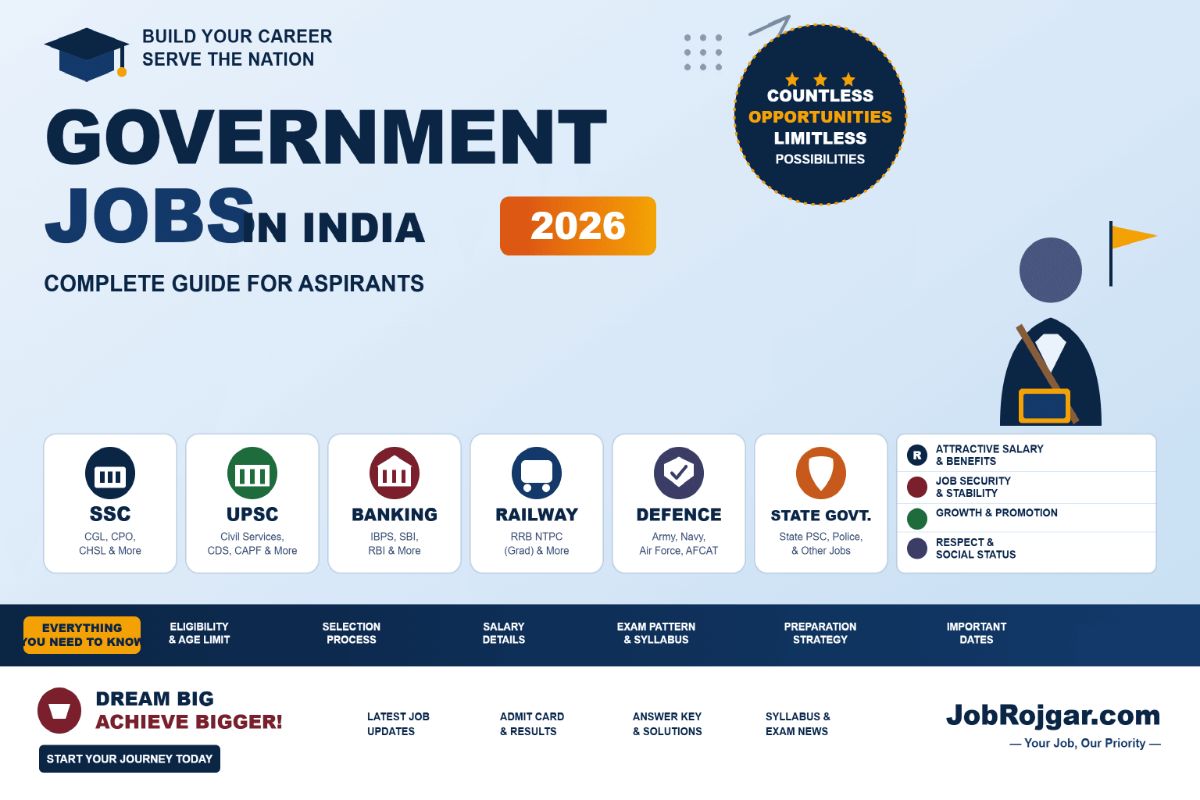
What Is a Government Job?
A government job is employment with a government department, ministry, public authority or certain government-controlled organizations.
Government recruitment in India takes place through different organizations and recruitment bodies. Some major recruitment routes include:
-
UPSC
-
SSC
-
Railway Recruitment Boards
-
IBPS
-
SBI
-
State Public Service Commissions
-
State Staff Selection Commissions
-
Police Recruitment Boards
-
Defence recruitment authorities
-
Teaching recruitment bodies
-
Government departments and organizations
For example, UPSC currently lists examinations such as Civil Services, Combined Defence Services, National Defence Academy, Engineering Services, Combined Medical Services, CAPF and several other examinations.
How to Get a Government Job in India?
The basic process can be understood in these steps:
Step 1: Decide Which Government Job You Want
First decide what type of government career you want.
For example:
-
Administrative Officer
-
Income Tax Inspector
-
Assistant Section Officer
-
Bank PO
-
Clerk
-
Railway employee
-
Police Officer
-
Defence Officer
-
Teacher
-
Engineer
-
Medical Officer
-
Accountant
-
Court/Legal employee
-
Government Assistant
-
State Government Officer
Your target job will determine which examination you should prepare for.
Step 2: Check Your Educational Qualification
Government jobs are available for candidates with different educational qualifications.
Government Jobs After 10th
Candidates who have passed Class 10 can find opportunities such as:
-
MTS-type posts
-
Constable posts
-
Railway Level/entry-level posts when notified
-
Various state government posts
-
Defence-related entry routes
-
Apprenticeships
-
Support staff positions
Eligibility differs from one recruitment notification to another.
Government Jobs After 12th
12th-pass candidates can target opportunities such as:
-
SSC CHSL
-
Stenographer
-
Police/Constable recruitment
-
Defence recruitment
-
Railway recruitment
-
State government clerical posts
-
Various departmental recruitments
SSC conducts examinations for multiple levels. Its examination ecosystem includes CGL, CHSL, Selection Posts, Stenographer, GD, SI and other examinations.
Government Jobs After Graduation
Graduates have a much wider range of options, including:
-
SSC CGL
-
UPSC Civil Services
-
SSC CPO
-
Banking
-
Railway graduate-level posts
-
State PSC
-
Insurance
-
Defence officer entries
-
CAPF
-
Government teaching
-
Various department-specific examinations
-
PSU recruitment, where applicable
Step 3: Choose the Right Government Exam
Choosing the right examination is one of the most important decisions.
Don't prepare randomly for every government exam.
Instead, select examinations according to:
-
Your qualification
-
Age
-
Subject strength
-
Career interest
-
Physical requirements
-
Preferred department
-
State preference
-
Salary expectations
-
Competition level
-
Examination pattern
Major Government Exams in India
1. SSC Exams
The Staff Selection Commission is one of the most important recruitment bodies for Central Government jobs.
Popular SSC examinations include:
SSC CGL
SSC Combined Graduate Level is one of the most popular choices for graduates.
Depending on the recruitment cycle and available posts, candidates can compete for positions such as:
-
Assistant Section Officer
-
Inspector
-
Auditor
-
Accountant
-
Tax-related posts
-
Assistant
-
Statistical/other specialized posts where eligible
SSC's official examination information lists graduate-level recruitment among its major examination activities.
SSC CHSL
SSC CHSL is designed for eligible 12th-pass candidates and includes posts such as clerical and data-entry-related positions, depending on the recruitment notification.
SSC MTS
This is an important route for eligible candidates at the matriculation level.
SSC CPO
SSC CPO is a major route for eligible candidates seeking Sub-Inspector positions in Delhi Police and Central Armed Police Organizations.
SSC Selection Posts
Selection Posts recruitment covers different posts with eligibility varying according to the individual vacancy.
Important: Always check the current SSC notification for educational qualification, age limit, vacancy, exam pattern and post-specific requirements.
2. UPSC Government Jobs
The Union Public Service Commission conducts some of India's most prestigious competitive examinations.
Important UPSC examinations include:
-
Civil Services Examination
-
Engineering Services Examination
-
Combined Defence Services
-
NDA & Naval Academy
-
CAPF
-
Combined Medical Services
-
Indian Forest Service
-
Indian Economic Service
-
Indian Statistical Service
-
Combined Geo-Scientist
The UPSC 2026 examination schedule currently includes Civil Services, CDS, NDA, Engineering Services, Medical Services, CAPF and other examinations.
UPSC Civil Services Examination
Civil Services is one of India's most competitive examinations.
Successful candidates may enter services such as:
-
IAS
-
IPS
-
Indian Foreign Service
-
IRS
-
Other Central Civil Services
The Civil Services Examination generally involves:
-
Preliminary Examination
-
Main Examination
-
Personality Test/Interview
The exact rules, eligibility and service allocation are determined by the relevant year's official notification.
3. Banking Government/Sector Jobs
Banking is another popular career option for graduates.
Major recruitment routes include:
-
IBPS PO
-
IBPS Clerk
-
IBPS RRB
-
SBI PO
-
SBI Clerk
-
RBI recruitment
-
NABARD recruitment
-
Other financial-sector recruitment
IBPS's 2026 PO/MT recruitment cycle has an official notification and updated vacancy information, showing that banking recruitment continues to be an important route for graduates.
Banking examinations commonly test areas such as:
-
Reasoning
-
Quantitative Aptitude
-
English
-
General Awareness
-
Banking Awareness
-
Computer/other sections depending on the examination
4. Railway Government Jobs
Indian Railways is another major source of employment.
Depending on recruitment notifications, opportunities can include:
-
Technician
-
Assistant
-
NTPC-related posts
-
Group-level posts
-
Junior Engineer
-
Various technical positions
-
Apprentice opportunities
-
Other railway vacancies
Railway recruitment requirements differ significantly between posts, so candidates should always check the relevant Railway Recruitment Board notification before applying.
5. Defence Government Jobs
Candidates interested in defence careers can explore:
-
Indian Army
-
Indian Navy
-
Indian Air Force
-
CDS
-
NDA
-
AFCAT
-
CAPF
-
Various technical entries
-
Other recruitment schemes
Defence recruitment may involve additional requirements such as:
-
Physical fitness
-
Medical standards
-
Height/weight requirements
-
Vision standards
-
Physical tests
-
Written examination
-
Interview or selection board
Therefore, defence aspirants should start physical preparation along with academic preparation.
6. State Government Jobs
Don't focus only on Central Government jobs.
Every state has its own recruitment ecosystem.
Depending on the state, candidates may find recruitment through:
-
State PSC
-
State SSC
-
Police recruitment boards
-
State education departments
-
Revenue departments
-
Health departments
-
Municipal bodies
-
Courts
-
Other state departments
Examples include:
-
UPPSC
-
BPSC
-
MPPSC
-
RPSC
-
MPSC
-
HPSC
-
WBPSC
-
UKPSC
-
CGPSC
-
JPSC
-
APPSC
-
TSPSC
-
KPSC
-
TNPSC
The exact organization and recruitment structure differs by state.
Step 4: Understand the Eligibility Criteria
Before preparing for an examination, check the eligibility criteria carefully.
Common eligibility conditions include:
Educational Qualification
The required qualification may be:
-
10th pass
-
12th pass
-
Graduation
-
Post-graduation
-
Diploma
-
ITI
-
Engineering degree
-
Medical degree
-
Law degree
-
Other specialized qualification
Some posts require a specific subject or professional qualification.
Age Limit
Government examinations commonly specify minimum and maximum age limits.
Age limits are not the same for every examination.
Relaxation may be available to eligible categories according to the applicable government rules.
Therefore, never assume that an age limit from one examination applies to another.
Always check the age calculation date and relaxation rules in the latest official notification.
Step 5: Understand the Selection Process
A government recruitment process may contain one or more stages.
A common selection process can look like:
Notification → Application → Written Exam → Skill/Physical Test → Document Verification → Medical Examination → Final Selection
However, every examination has its own process.
For example:
SSC
Depending on the examination:
-
Computer-Based Examination
-
Tier/stage-based examinations
-
Skill Test
-
Physical Test
-
Document Verification
UPSC
Depending on the examination:
-
Preliminary
-
Main
-
Interview/Personality Test
Banking
Depending on the recruitment:
-
Preliminary Examination
-
Main Examination
-
Interview, where applicable
-
Final selection
Defence
Depending on entry:
-
Written Examination
-
Physical/medical requirements
-
Interview/selection process
-
Document verification
-
Final merit
Step 6: Download and Read the Official Notification
This is one of the most important steps.
Before applying for any government job, read the complete notification.
Check:
-
Post name
-
Vacancy
-
Qualification
-
Age limit
-
Age relaxation
-
Application dates
-
Application fee
-
Exam date
-
Exam pattern
-
Syllabus
-
Selection process
-
Documents
-
Category rules
-
Reservation rules
-
Physical requirements
-
Medical requirements
-
Important instructions
Do not depend only on YouTube videos, Telegram messages, social media posts or third-party websites.
Use them for information, but verify important details against the official notification.
For example, UPSC publishes examination notifications, results, admit cards and other recruitment information on its official website.
Step 7: Apply Online Carefully
Once you find an eligible vacancy, complete the application before the deadline.
Typical application steps include:
-
Open the official recruitment website.
-
Register for the examination.
-
Enter personal information.
-
Enter educational details.
-
Select category and other applicable details.
-
Upload photograph and signature.
-
Upload other documents if required.
-
Pay the application fee, if applicable.
-
Submit the application.
-
Download or save the final application form.
-
Save the payment receipt.
Important Tip
Do not wait until the final day.
Website traffic, payment problems, incorrect information and technical issues can cause unnecessary problems.
Documents Required for Government Job Applications
Depending on the recruitment, candidates may need:
-
Aadhaar or another accepted identity document
-
Passport-size photograph
-
Signature
-
10th certificate
-
12th certificate
-
Graduation certificate/marksheet
-
Diploma/ITI certificate
-
Category certificate, if applicable
-
EWS certificate, if applicable
-
PwBD certificate, if applicable
-
Experience certificate, where required
-
Domicile certificate, where required
-
NOC for applicable candidates
-
Other documents specified in the notification
Always follow the exact document requirements in the notification.
How to Prepare for a Government Job Exam
Getting a government job requires consistent preparation.
You don't necessarily need to study 12–14 hours every day.
A better approach is:
Consistency + Correct Strategy + Mock Tests + Revision
Step 1: Understand the Syllabus
Before starting preparation, download the latest syllabus.
Make a list of every topic.
For example, many competitive exams include subjects such as:
Quantitative Aptitude
-
Number System
-
Percentage
-
Profit and Loss
-
Ratio and Proportion
-
Average
-
Time and Work
-
Time, Speed and Distance
-
Simple Interest
-
Compound Interest
-
Algebra
-
Geometry
-
Mensuration
-
Data Interpretation
Reasoning
-
Analogy
-
Classification
-
Coding-Decoding
-
Series
-
Blood Relations
-
Direction
-
Ranking
-
Syllogism
-
Statement-based questions
-
Puzzles
-
Seating Arrangement
English
-
Grammar
-
Vocabulary
-
Reading Comprehension
-
Error Detection
-
Sentence Improvement
-
Cloze Test
-
Synonyms
-
Antonyms
-
Para Jumbles
General Awareness
-
Indian History
-
Geography
-
Polity
-
Economy
-
Science
-
Current Affairs
-
Government Schemes
-
Important Organizations
-
Awards
-
Sports
-
Important Days
The exact syllabus depends on the examination.
Step 2: Make a Study Timetable
A practical timetable can look like this:
| Time | Subject |
|---|---|
| 6:00–7:00 AM | Current Affairs |
| 7:00–8:00 AM | Quantitative Aptitude |
| 10:00–11:00 AM | English |
| 2:00–3:00 PM | General Awareness |
| 6:00–7:00 PM | Reasoning |
| 9:00–10:00 PM | Revision/Mock Test |
You don't have to follow this exact schedule.
Create a timetable according to your college, job and personal routine.
Step 3: Study Previous Year Question Papers
Previous year papers are extremely useful.
They help you understand:
-
Difficulty level
-
Frequently asked topics
-
Question patterns
-
Time pressure
-
Important chapters
-
Your weak areas
Try to solve previous year papers under actual exam conditions.
Step 4: Take Mock Tests
Mock tests should become part of your preparation.
Initially, you can take fewer mocks.
As the examination approaches, increase the frequency.
After every mock test, analyze:
-
Wrong answers
-
Unattempted questions
-
Time-consuming questions
-
Guessing mistakes
-
Weak subjects
-
Repeated mistakes
Simply taking hundreds of mocks without analysis is less useful than taking fewer tests and properly analyzing them.
Step 5: Improve Speed and Accuracy
Competitive examinations are not only about knowing the answer.
You must solve questions:
Quickly + Correctly
For example, if you know mathematics but spend too much time on each question, you may struggle to complete the paper.
Practice:
-
Mental calculations
-
Short methods where appropriate
-
Time management
-
Question selection
-
Accuracy
Step 6: Make Short Notes
Prepare short revision notes for:
-
Current affairs
-
Important facts
-
Formulas
-
Vocabulary
-
Government schemes
-
History dates
-
Geography facts
-
Polity
-
Important organizations
Revise these notes regularly.
How Long Does It Take to Get a Government Job?
There is no fixed time.
Some candidates qualify in their first attempt, while others need several attempts.
Your preparation time depends on:
-
Examination difficulty
-
Competition
-
Your educational background
-
Current preparation level
-
Number of hours available
-
Exam syllabus
-
Previous experience
-
Mock-test performance
Instead of asking:
“How many months will it take?”
ask:
“Am I improving every month?”
Can Freshers Get Government Jobs?
Yes.
Many government recruitment examinations are designed for eligible candidates without prior government-job experience.
For freshers, the most important things are:
-
Eligibility
-
Exam preparation
-
Correct documents
-
Consistent practice
-
Understanding the selection process
Don't reject a vacancy simply because you have no work experience. First check whether experience is actually required in the notification.
Can Final-Year Students Apply?
It depends on the examination.
Some examinations allow candidates who are appearing in their final year, while others require the qualification to be completed by a specified date.
Therefore, final-year students should carefully check the relevant notification's qualification and cutoff-date rules.
Government Jobs Without an Interview
Not every government recruitment includes an interview.
Many recruitments are based on combinations of:
-
Written examination
-
Computer-based examination
-
Skill test
-
Physical test
-
Document verification
-
Medical examination
The exact selection process depends on the post and recruiting organization.
Candidates should not assume that every government job requires an interview.
Government Jobs for Graduates
Graduation opens many opportunities.
BA Graduates
Possible areas include:
-
SSC
-
UPSC
-
Banking
-
State PSC
-
Police
-
Railway
-
Administrative positions
-
Various government departments
B.Com Graduates
Possible areas include:
-
Banking
-
SSC
-
Accounts-related positions
-
Insurance
-
Finance-related government organizations
-
State government jobs
B.Sc Graduates
Depending on specialization:
-
SSC
-
UPSC
-
Scientific organizations
-
Technical/scientific recruitment
-
Banking
-
State government
-
Defence
B.Tech/BE Graduates
Possible areas include:
-
Engineering Services
-
PSU opportunities
-
Technical government departments
-
Railway technical jobs
-
Defence technical roles
-
SSC technical posts
-
State engineering recruitment
BCA/MCA Graduates
Potential areas include:
-
IT-related government positions
-
Programmer/technical recruitment
-
SSC
-
Banking
-
State government technical jobs
-
Government technology organizations
How to Find New Government Job Notifications
The biggest mistake many candidates make is discovering a vacancy after the application deadline.
Make a daily or weekly routine to check recruitment updates.
Follow:
-
Official recruitment websites
-
Government employment portals
-
Recruiting organizations
-
State PSC websites
-
SSC
-
UPSC
-
Railway Recruitment Boards
-
IBPS
-
SBI
-
Defence recruitment portals
You can also use trusted job portals such as JobRojgar to discover new government job notifications, but always verify the final eligibility and application details from the official notification.
How JobRojgar Can Help Government Job Aspirants
JobRojgar can be used as a centralized source for discovering recruitment-related updates.
Candidates can organize their search around categories such as:
A useful strategy is:
Find the opportunity → Read Job Details → Check Official Notification → Verify Eligibility → Apply on Official Website → Track Admit Card → Prepare → Check Result
How to Avoid Government Job Scams
Government job aspirants are sometimes targeted by fake recruitment advertisements.
Be careful if someone promises:
-
Guaranteed government job
-
Direct government appointment
-
Job without eligibility
-
Job in exchange for money
-
Guaranteed selection
-
Fake appointment letter
-
Fake interview
-
Fake recruitment website
Never Pay for Guaranteed Selection
Legitimate recruitment follows an official process.
If someone says:
“Pay ₹50,000 and your government job is guaranteed.”
Treat it as a major warning sign.
How to Verify a Government Job Notification
Before applying, check:
1. Recruiting Organization
Who is conducting the recruitment?
2. Official Website
Is the notification available on the organization's official website?
3. Notification Number
Does the advertisement have a valid notification/advertisement number?
4. Application URL
Does the application link belong to the appropriate official recruitment system?
5. Eligibility
Do you actually satisfy the qualification and age requirements?
6. Dates
Check:
-
Start date
-
Last date
-
Correction date
-
Examination date
-
Admit card date, when available
7. Payment
Verify the application fee and payment process from the official notification.
Common Mistakes Government Job Aspirants Make
Mistake 1: Preparing for Too Many Exams
Preparing simultaneously for UPSC, SSC, Banking, Railway and every state exam can reduce your focus.
Choose exams with overlapping syllabi where possible.
Mistake 2: Ignoring the Syllabus
Don't study random topics.
Start with the official syllabus.
Mistake 3: Not Solving Previous Papers
Reading books alone is not enough.
Practice actual previous questions.
Mistake 4: Not Taking Mock Tests
Mock tests help you understand your actual preparation level.
Mistake 5: Ignoring Current Affairs
For exams where current affairs are part of the syllabus, regular revision is important.
Mistake 6: Applying Without Checking Eligibility
Never apply blindly.
Check:
-
Qualification
-
Age
-
Category
-
Subject requirement
-
Experience
-
Physical standards
-
Other conditions
Mistake 7: Waiting Until the Last Day
Submit your application early.
Best Strategy for Government Job Preparation in 2026
A simple strategy is:
Phase 1 – Foundation
First 1–2 months
Focus on:
-
Basic concepts
-
Mathematics
-
Reasoning
-
English
-
General Awareness
Phase 2 – Practice
Next 2–3 months
Focus on:
-
Topic-wise questions
-
Previous papers
-
Speed
-
Accuracy
-
Current affairs
Phase 3 – Mock Tests
Take regular full-length tests.
Analyze every test.
Phase 4 – Revision
Revise:
-
Formulas
-
Current affairs
-
Vocabulary
-
Important facts
-
Weak topics
Phase 5 – Examination
During the final period:
-
Avoid learning too many new topics.
-
Revise important material.
-
Solve mock tests.
-
Maintain proper sleep.
-
Keep documents ready.
-
Check examination instructions.
How to Prepare for SSC Exams
For SSC aspirants, focus heavily on:
Quantitative Aptitude
Build strong fundamentals and practice regularly.
Reasoning
Practice different question types repeatedly.
English
Improve grammar, vocabulary and comprehension.
General Awareness
Create short notes and revise frequently.
SSC's official website provides examination-related information including syllabus, previous-year question resources, examination calendar and other candidate resources.
How to Prepare for UPSC
UPSC preparation requires a broader strategy.
Focus on:
-
NCERT/basic concepts
-
Indian Polity
-
History
-
Geography
-
Economy
-
Environment
-
Science and Technology
-
Current Affairs
-
Answer writing
-
Previous year questions
-
Essay preparation
-
Optional subject, where applicable
UPSC publishes examination-specific notifications, schedules and results, so aspirants should use the official examination page for the current cycle.
How to Prepare for Banking Exams
Banking aspirants should focus on:
-
Quantitative Aptitude
-
Reasoning
-
English
-
Current Affairs
-
Banking Awareness
-
Financial Awareness
-
Computer-related topics where applicable
Speed is particularly important because banking examinations are generally time-bound competitive tests.
How to Prepare for Railway Exams
Railway preparation should be based on the exact examination.
Common preparation areas may include:
-
Mathematics
-
General Intelligence/Reasoning
-
General Awareness
-
General Science
-
Technical subjects for technical posts
Always follow the syllabus of your particular Railway recruitment.
How to Prepare for State Government Jobs
For State Government examinations, prepare both:
Common Subjects
-
Mathematics
-
Reasoning
-
English/Hindi
-
General Awareness
-
Current Affairs
State-Specific Subjects
-
State history
-
State geography
-
State polity
-
State economy
-
State schemes
-
State current affairs
-
Local culture
The exact syllabus differs by state and examination.
Salary in Government Jobs
Government salary varies significantly depending on:
-
Post
-
Pay level
-
Department
-
Central/State Government
-
Location
-
Allowances
-
Experience
-
Promotion
Depending on the job, employees may receive components such as:
-
Basic pay
-
Dearness allowance
-
House-related allowance where applicable
-
Transport allowance
-
Other applicable allowances
-
Leave benefits
-
Retirement-related benefits according to applicable rules
Never judge a job only by the advertised basic salary. Check the complete notification and applicable pay structure.
Benefits of Government Jobs
Government employment can provide several advantages depending on the post and applicable rules.
These may include:
-
Career stability
-
Structured pay
-
Promotion opportunities
-
Allowances
-
Leave benefits
-
Social status
-
Retirement-related benefits
-
Job-specific facilities
-
Opportunities for departmental growth
However, benefits vary between organizations and posts.
Is a Government Job Better Than a Private Job?
There is no universal answer.
Government Job
Possible advantages:
-
Stability
-
Structured career progression
-
Government benefits
-
Predictable recruitment framework
Possible limitations:
-
Highly competitive examinations
-
Recruitment can take time
-
Limited number of vacancies
-
Transfers may occur
-
Selection can require multiple stages
Private Job
Possible advantages:
-
Faster hiring
-
More industry options
-
Skill-based growth
-
Potentially faster salary growth
Possible limitations:
-
Job security can vary
-
Performance pressure
-
Working hours may vary
-
Benefits differ between companies
The right choice depends on your career goals.
Government Job Preparation Checklist
Before applying for any government job, ask yourself:
-
Do I meet the educational qualification?
-
Am I within the age limit?
-
Is my category certificate valid if required?
-
Have I read the complete notification?
-
Do I understand the selection process?
-
Have I checked the syllabus?
-
Have I checked the application deadline?
-
Do I have the required documents?
-
Have I prepared my photograph and signature?
-
Have I saved the application receipt?
-
Am I preparing with previous-year papers?
-
Am I taking mock tests?
-
Am I tracking admit card and result updates?
Frequently Asked Questions (FAQs)
1. How can I get a government job in India?
Choose a suitable government examination according to your qualification, check eligibility, apply for the relevant recruitment and prepare for all stages of the selection process.
2. Which government exam is best?
There is no single best examination. SSC, UPSC, Banking, Railway, Defence and State Government exams are suitable for different candidates.
3. Can I get a government job after 12th?
Yes. Several government recruitment examinations and departmental opportunities are available for eligible 12th-pass candidates.
4. Can I get a government job after graduation?
Yes. Graduation opens opportunities through SSC, UPSC, Banking, Railway, State PSC, Defence and other recruitment routes.
5. Is government job preparation difficult?
Government examinations can be highly competitive, but disciplined preparation, previous-year papers, mock tests and regular revision can improve your chances.
6. How many hours should I study?
There is no fixed number. Focus on consistent, productive study rather than simply counting hours.
7. Can freshers apply for government jobs?
Yes, when the relevant recruitment allows candidates without prior experience.
8. Can final-year students apply?
It depends on the particular examination's eligibility and qualification cutoff rules.
9. Are government jobs permanent?
The nature of employment depends on the post, appointment terms and applicable government rules. Do not assume every recruitment has identical service conditions.
10. Do all government jobs require interviews?
No. The selection process varies by recruitment. Some selections may rely on written/CBT examinations, skill or physical tests, document verification and other stages.
11. Is SSC CGL good for graduates?
SSC CGL is a major graduate-level Central Government recruitment examination and can be an attractive option for eligible graduates.
12. Is UPSC only for IAS?
No. UPSC conducts many examinations for different services and posts.
13. Can I prepare for SSC and Banking together?
Yes, because several subjects overlap. However, you should separately prepare for examination-specific sections and patterns.
14. How can I find new government vacancies?
Monitor official recruitment websites and trusted job portals. Always verify the final information from the official notification.
15. How do I know whether a government job notification is genuine?
Check the recruiting organization's official website, notification number, official application process and complete advertisement.
16. Can I get a government job without an exam?
Some government appointments may use different recruitment mechanisms, but you should never assume that a vacancy is “exam-free.” Check the official recruitment notification.
17. What documents are required?
Documents depend on the recruitment but may include identity proof, educational certificates, photograph, signature, category certificates and other specified documents.
18. How important are previous-year papers?
They are extremely useful for understanding question patterns, difficulty and frequently tested topics.
19. Are mock tests necessary?
They are strongly recommended for competitive examinations because they help improve speed, accuracy and time management.
20. Can I apply for multiple government jobs?
Yes, provided you independently satisfy the eligibility conditions and follow the application requirements for each recruitment.
Final Words
Getting a government job in India requires a combination of the right exam choice, eligibility awareness, consistent preparation, regular practice and patience.
Don't prepare simply because an examination is popular. First identify the type of career you want and then choose examinations that match your qualification and strengths.
Your preparation should follow a simple cycle:
Choose the Exam → Check Eligibility → Read Notification → Study Syllabus → Practice → Solve Previous Papers → Take Mock Tests → Revise → Apply → Appear in Exam → Track Result
In 2026, candidates should also pay close attention to official recruitment websites because examination calendars, vacancies, deadlines and recruitment rules can change. For example, SSC maintains an examination calendar and candidate resources, while UPSC publishes current examination schedules and recruitment information on its official platform.
The most important rule is simple:
Don't chase every government vacancy. Choose the right opportunity and prepare for it seriously.
Useful Government Recruitment Sources
Always verify the latest recruitment notification before applying.
Disclaimer
This article is for general educational and informational purposes. Government recruitment rules, vacancies, age limits, qualifications, examination patterns, application dates, salary/pay levels and selection procedures may change from one recruitment cycle to another. Candidates should always read the latest official notification issued by the concerned recruiting organization before applying.